

BOMBANANA! PLAYER GUIDE
The complete BOMBANANA guide for a reliable three-player team
Use this field guide to understand the game, choose the right reference page, and build a communication protocol that survives harder modules, Random pools, and Chaos interruptions.
What is BOMBANANA!?
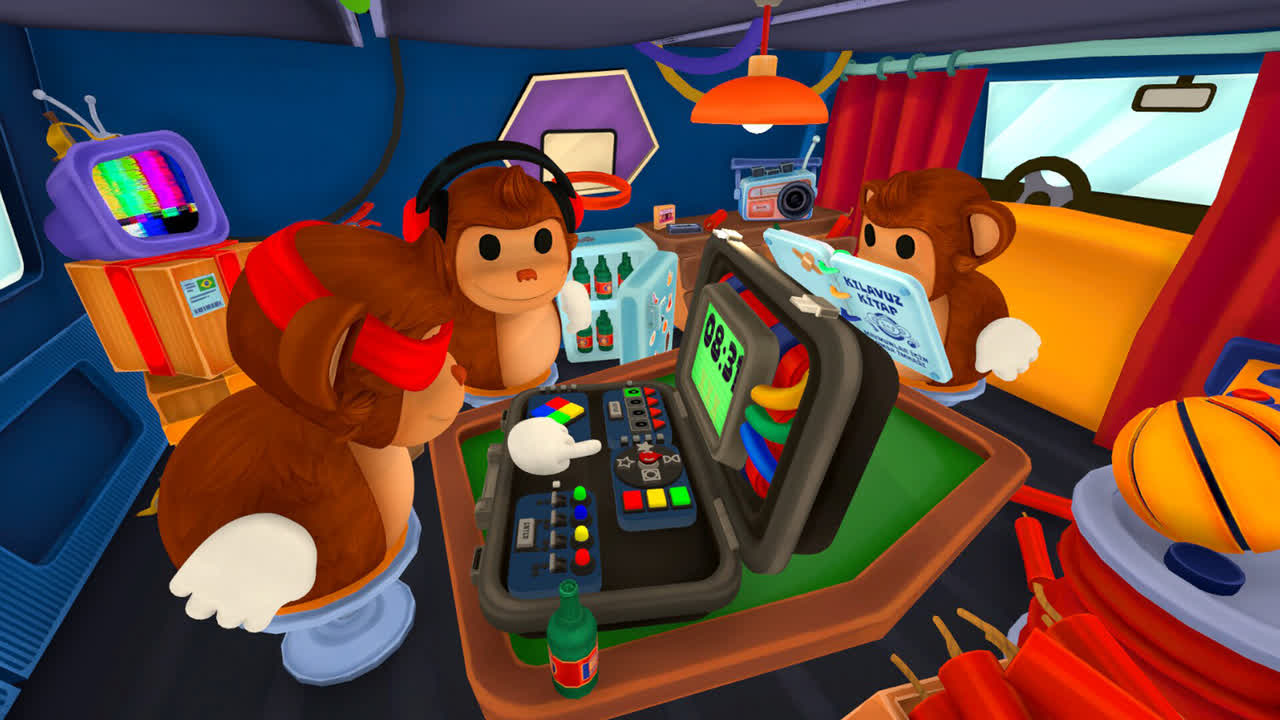
BOMBANANA! is a cooperative puzzle game for exactly three players. The team enters a mobile bomb workshop as Blind Monkey, Mute Monkey, and Deaf Monkey. Each role is deliberately missing one channel of information, so nobody can inspect the bomb, read the manual, speak, hear, and operate at the same time. A successful BOMBANANA run therefore depends on moving a precise description through the whole team before a hand touches the panel. The puzzles matter, but the communication system is the real game.
This BOMBANANA guide treats every answer as an information packet. Deaf reports the visible state, Mute interprets the relevant manual rule, and Blind converts the returned answer into one physical input. That model works across Campaign, Endless, and Custom play because it does not depend on memorizing a particular random bomb. When BOMBANANA introduces a new module or environmental interruption, the same packet can expand without forcing your group to invent a new language under pressure.
How to use this BOMBANANA wiki
Start with the BOMBANANA levels index when you need a timer, mistake limit, fixed module, Random difficulty pool, or Chaos load for a Campaign mission. Open the module index when a panel name is known but your team needs the reporting order. Use the roles guide before a first session or after changing seats. The achievement tracker is for completion planning, while the source log explains which BOMBANANA claims come from Steam, structured game data, or community testing.
Search is available in the header and at the top of this page. A query such as “Level 20,” “Switch,” “Alarm,” “Blind,” or “Endless Master” opens the shortest route to the relevant BOMBANANA entry. Every index links to its detailed pages with descriptive anchor text, and every detail page links back to the wider collection. This structure is intentional: a player can move from a failed BOMBANANA attempt to the exact procedure, then return to the surrounding level without losing context.
The three BOMBANANA monkey roles
Blind Monkey is the operator. Blind can touch the bomb but cannot rely on colors or readable displays, so instructions must end in a physical location: first cable from the left, upper-right button, or switch two down. Mute Monkey owns the BOMBANANA defusal manual and turns a noisy set of observations into one concise result, but cannot speak. Deaf Monkey sees the bomb and the gestures, can speak to Blind, and acts as the relay that keeps both sides synchronized.
The safest BOMBANANA callout follows six parts: module name, current stage, required fields, manual answer, physical position, and repeat-confirm. Skipping the module name sends Mute to the wrong rule. Skipping the stage can reuse an expired answer. Skipping the physical position leaves Blind guessing. A short BOMBANANA sentence is not automatically a good sentence; the best callout is the shortest packet that still carries every field the current panel needs.
How BOMBANANA Campaign progression changes
The full BOMBANANA release contains 30 Campaign levels. Early missions use fixed easy modules to teach position words and confirmation. Middle missions add longer packets, symbols, note sequences, and persistent Chaos duties. Later BOMBANANA levels introduce hard modules, more Random pools, shorter decision windows, and combinations that punish a team for forgetting state after an interruption. The level index records those structural changes without pretending that a Random slot has one permanent solution.
A fixed slot can be studied before the timer starts because its module family is known. A Random Easy, Medium, or Hard slot tells you which procedures might be selected, not which answer will appear. That distinction is central to this BOMBANANA wiki. The useful preparation is to rehearse observation order, hand signals, and recovery rules for the whole pool. Memorizing one attractive answer from a previous BOMBANANA run is unsafe when colors, Braille, symbols, or positions change.
BOMBANANA defusal and Chaos modules
The module library covers 11 defusal modules and three Chaos modules. Defusal panels include Cable, Color Slider, Direction, Calculator, Symbol, Piano, Soundboard, Switch, Maze, Morse, and Monkey-Says. A BOMBANANA module page lists the observations that must be collected, a repeatable callout sequence, known fixed Campaign appearances, and whether a public table has been verified. Where a complete mapping is not public, the page says so instead of inventing a plausible-looking rule.
Pressure, Slider, and Alarm are ongoing BOMBANANA interruptions rather than ordinary one-and-done puzzles. Pressure and Slider require an assigned watcher who protects a safe threshold. Alarm creates a short heated-button response window. The important BOMBANANA recovery rule is the same for all three: announce the interruption, take hands off the main chain, clear the emergency, then reread the active module from its current state. Never assume a half-finished packet survived the break.
How this BOMBANANA guide handles evidence
BOMBANANA changed substantially between its public demo and the September 2, 2026 full release. Pages that still describe seven Campaign levels, a Windows-only build, or an unreleased price are no longer a safe baseline. This BOMBANANA guide begins with the current Steam listing and official announcements, then uses platform records and a version-marked data source for facts Steam does not expose in a compact table. Community procedures are clearly labeled and linked to their origin.
Evidence labels are not decorative. “Official” means the claim comes from the developer, publisher, or Steam store. “Platform data” covers records such as Steam achievements. “Data-backed” marks structured BOMBANANA information that can be cross-checked but is not an official manual. “Community-tested” identifies useful player procedures that may need confirmation against the live game. A stale BOMBANANA source remains listed only when it helps explain a conflict; it is never silently blended into current advice.
A practical first BOMBANANA session
Before launching BOMBANANA, assign the three roles and decide whose viewpoint defines left and right. Agree on gestures for yes, stop, repeat one field, and full reread. Open the module index on a second screen, then practice the six-part packet without a timer. For the first BOMBANANA levels, measure clean confirmations rather than speed. A deliberate ten-second exchange is faster than losing a mistake to an ambiguous color or touching the correct control in the wrong position.
After each BOMBANANA attempt, record one communication failure instead of blaming a player. If Mute opened the wrong rule, improve the module name. If Blind moved early, strengthen the confirmation signal. If Chaos erased context, make the restart phrase explicit. The goal of a BOMBANANA practice session is not merely to clear the next level; it is to build a protocol that still works when the timer tightens, the room becomes noisy, and several modules compete for attention.
- Choose Blind, Mute, and Deaf before entering the lobby.
- Define left, right, rows, columns, and numbered positions from Blind’s view.
- Use one speaker, one packet, and one confirmation at a time.
- Assign a dedicated watcher whenever a BOMBANANA level includes Chaos.
- After any interruption, reread the active panel instead of trusting memory.